
The Residues | 10 Oct 2026 - 09 Jan 2027

The solo exhibition The Residues by artist Onya McCausland explores industrial waste as a material through which to reimagine landscape and examine our evolving relationship with the living world.
About
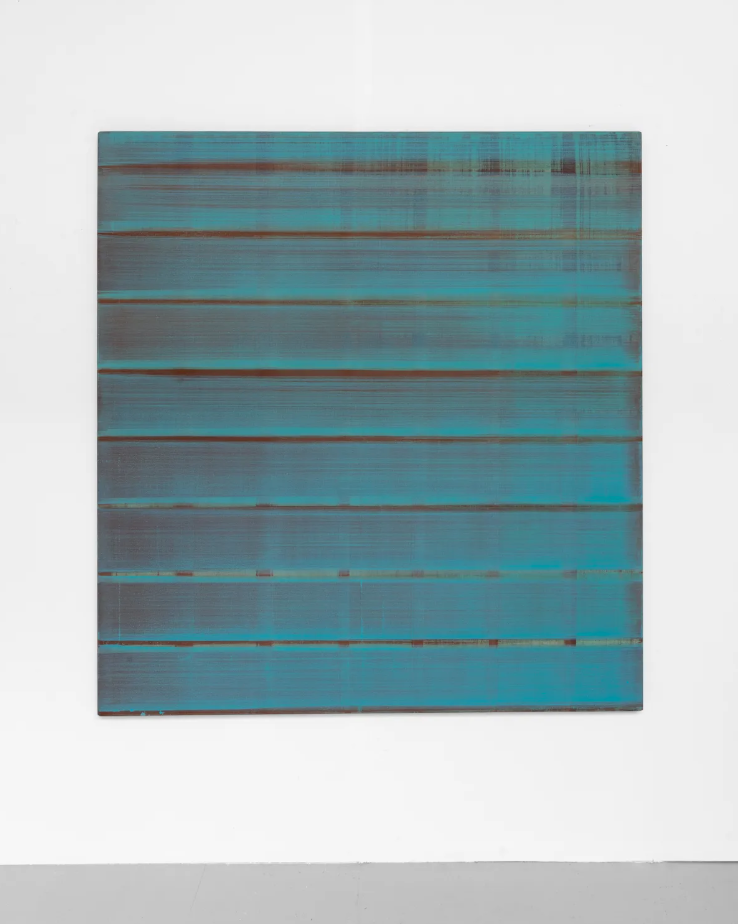
The Residues presents new works by Onya McCausland, continuing her ongoing investigation into landscapes transformed by extraction, industry and environmental change.
Her paintings speak to sites where the earth has undergone post-extractive alteration: landscapes in which chemical balances have been disrupted, materials displaced, and environments fundamentally transformed through industrial activity.
McCausland makes her paintings using materials collected from industrial land sites, mine tailings and waste dams, transforming these residues into dense, site-specific colour. Through this process, industrial contaminants are reconfigured as contemporary painting materials carrying traces of the places from which they came and making visible the structural changes that have taken place within the earth’s systems.
Her practice proposes a different way of understanding waste: not as something external to the landscape, but as part of its contemporary material history.
McCausland’s deep engagement with geology, chemistry and site-specific research gives the paintings an unusual material authority. Their surfaces are not symbolic approximations of landscape; they are landscapes chemically and historically compressed into pigment.
Burning, milling and refining the minerals alters their tone, density and texture. Subtle shifts in colour changes in warmth, opacity or granularity become records of process, geology and industrial history.
The paintings operate less as images of landscape than as material documents, carrying within their surfaces traces of extraction, transformation and ecological aftermath. They hold the memory of places altered by industry while asking us to reconsider the materials through which landscape is understood.
PROPOSITION & CLOSE Gallery
Both Proposition and CLOSE Gallery are grounded by a shared ethos of ecological awareness, care and responsible stewardship.
Proposition holds an ethos attentive to ecological interdependence, supporting artists whose practices engage critically with environmental change while creating spaces for exchange between artists, researchers and communities. Its concurrent live programme extends this commitment, exploring experimental approaches to regenerative practice and the intersections of social and environmental justice. Through exhibitions, conversations and public activations, It considers how artistic research and its surrounding discourses might develop ecologically attuned practices that respond to climate concerns and reframe our evolving relationship with the living world.
CLOSE Gallery is a slow, green gallery based in Somerset, operating through a similarly considered approach to exhibition-making, artistic research and environmental responsibility.
For more information on Onya McCausland contact info@closeltd | www.closeltd.com
Artist Biography
Onya McCausland
Onya McCausland’s practice combines studio paintings, wall installations, and collaborative socially focused works that include making and using paint from waste materials to develop critical perspectives that examine and re-imagine industrial contaminants and pollution from mines as contemporary cultural materials that indicate and symbolise the structural environmental changes to the earth's systems.
McCausland’s paintings develop contexts of landscape, abstraction and monochrome painting which are explored together to address environmental contexts and concerns, and specifically environments and sites in which mining industries leave their mark and make landscapes toxic or dangerous through the remains of waste in the land and water. In this, she explores an environmentalism that addresses the materials and materiality of how painting and paint relates to the earth (as being made from chemical elements and processes) and human cultures, as well as traditions of art that relate to specific sites and places. McCausland’s use of ochre has other references, including the earliest known use of ochre pigment by humans in cave painting, emphasising the relation of materials, community, site and environment.
Her paintings are concerned with the use of new sources of material for colour to address ways of seeing that develop and contribute to the histories and concepts of landscape painting. The work proposes new ways of perceiving and conceiving of landscapes through a materiality of place, and the overlap and conflation of human and geological time frames. Traditional tropes of landscape painting are explored to attend to surface, depth and perspectival orientations – views from above and on the ground – and to evoke a sense of place and displacement, distance and proximity.
This play on surface and perspective is further extended through works that includes aerial photographs of mining sites where ochre is visible as an element. A recent publication that McCausland co-edited; Aerial Landscapes 2023, contributes to research on contemporary landscape perspectives and the ways in which artists participate in industries beyond the art world and academia. It also develops thinking about key works by artist John Latham, and sheds new light on the pioneering work of Barbara Steveni, artist and co-founder of APG (Artists Placement Group), who was an innovator in negotiating artist placements including in industry and government departments. Aerial Landscapes considers the impact, value and significance of artists reaching beyond their disciplinary 'frame'. The book launch was accompanied by a display exploring and reflecting on the process of research, including art works by artist Nicky Bird and Onya McCausland alongside materials from the John Latham Archive and John Latham Collection at Flat Time House.
McCausland’s own innovative collaborative work with industry including the UK Coal Authority and paint manufacturers Winsor & Newton and Michael Harding paints is further developed in a recent collaboration with industrial paint consultant Nick Dubbels as an architectural intervention for Aberbeeg Hospital (Blaenau Gwent South Wales, image below). Here an exterior grade sustainable wood stain was made using mine waste ochre (Six Bells Red a pigment that she developed in 2020 from local industrial ochre sludge) and a sunflower based bio-resin recipe as a binder developed by Nick. This marked the first time these ingredients were combined as an industrial coating and now coat the former miners' hospital. The wider socio-cultural discourse running through this research was underpinned by sustained interaction and engagement with the patients and staff in which the material became part of a narrative. This underlined how waste materials are vibrant active agents in the context of an over consumptive society in the midst of the climate emergency.
Other recent examples of interior architectural wall works, installations and studio paintings that contribute to discourses of contemporary materiality, ecology and sustainability within art practice and wider use value have been shown in Deep Horizons (curated with the Roberts Institute of Art and Middlesborough Institute of Modern Art - MIMA) 2023, and Chemical City (curated by Esther Lesley and Elinor Morgan) 2022 also at Middlesborough Institute of Modern Art which was awarded Best Exhibition at the North East Culture Awards, and Embrace, an exhibition held at Norrtälje Konsthall, Sweden 2021, then Akureyri Art Museum, Akureyri, Iceland 2022.
For McCausland, the circularity of material exchange and its value needs to be interrogated and used as a mechanism to critique systems and strategies of land use and the management of pollution and waste in close proximity to communities with histories that remain affected by the social, economic and emotional legacies of the coal mining industry.
In 2020 McCausland established a Community Interest Company based in the former mining village of Six Bells in Blaenau Gwent, South Wales to turn ochreous waste sludge forming from the mine water pollution treatment process into usable industrial paint for sale. This community centred on a hands-on process of paint making which supported practical knowledge and the exchange of ideas about context and belonging. It was structured as a locally focused circular economy by recycling the waste and returning assets from paint sales back towards community benefit. Its impact locally has been important and transformative whilst also exposing deeply rooted issues of social inequality embedded as a legacy of the landscape's industrial history.